


Are your allergies acting up with a cat in the house? Truth be told! You need a hypoallergenic cat!
When you catch yourself constantly sneezing and itching, it can curb you from showing some love to your furry children. Fear not, because you’re not alone!
Cat allergies are roughly twice as common as dog allergies, according to the Asthma and Allergy Foundation of America, but who can resist a good-looking feline?
So, if you’re still longing for a pet cat, there are some hypoallergenic cat breeds to choose from.
These cat breeds are known to produce fewer allergens than most types. Keep in mind that no cat breed is completely hypoallergenic.
Our quick take: no cat is truly hypoallergenic. The main allergen, a protein called Fel d 1, is made in a cat's skin glands and saliva, and every breed produces it. Breeds often suggested for allergy sufferers include the Siberian, Balinese (and its Javanese variety), Oriental Shorthair, Devon Rex, Cornish Rex, Sphynx, Russian Blue, Bengal and Colorpoint Shorthair, but the evidence is mostly owner reports, and allergen levels vary more between individual cats than between breeds. Females and neutered males generally produce less Fel d 1 than intact males. Before you commit, spend a few hours with the specific cat (not just the breed), talk to an allergist, especially if you have asthma, and plan to cut allergens at home with a HEPA filter, a cat-free bedroom and regular cleaning.
What causes an allergic reaction to cats?
If you’re wondering about the root of the allergies you experience from cats, it’s surprisingly not the cat’s fur. Instead, it’s a type of protein called Fel D1.
All cats produce this protein, mainly in the glands of their skin and in their saliva. When a cat grooms, Fel d 1 spreads over the coat, then flakes off with dander and hair. The particles are tiny and sticky, so they float in the air for a long time and cling to furniture, bedding and clothes, which is why you can react in a home where a cat lives even when the cat isn't in the room.
Factors that affect allergen production in cats
You might not know what factors produce allergens. It might depend on the gender of a cat or its fur-type.
Here’s what you need to know!
- Intact (unneutered) male cats produce the most Fel d 1; neutering lowers it, and females generally produce less
- Kittens produce fewer allergens than adults, so a kitten that seems fine may cause more symptoms once grown
- Individual cats vary a lot, even within the same breed or litter
- Hair length and shedding matter less than many people think: shorter or curly coats may spread less dander around the house, but they don't stop the cat making the allergen
Top 10 hypoallergenic cat breeds
These breeds produce fewer allergens which make cat parenting with a sensitive nose quite easier! Allow this list of “hypoallergenic” cats to be your ultimate guide as you search for your perfect match!
1. Oriental Shorthair cat

The Oriental Shorthair is definitely considered a hypoallergenic cat breed. The coating of this Oriental feline is as noteworthy as its personality. While they make good pets for people with allergies, they can also entertain anyone with full enthusiasm as they love being the center of attention.
Make sure they're immersed enough in activities so they feel more alive and engaged, putting their curious energy in these hobbies.
2. Balinese cat

Also referred to as “longhaired Siamese,” these cats don’t look like they’re hypoallergenic. Despite their type of fur that makes them an unlikely hypoallergenic cat breed, it is surprisingly one of a handful of breeds that produce less Fel D1 protein than other cats.
So you're generally safe to keep a Balinese cat.
These adorable-looking cats are quite intelligent, sweet, and fun to have around! They are a lot like the Siamese, for being vocal and loud when communicating with you.
Do note that the Balinese cats are quite sensitive to your mood and their sociable nature keeps any cat owner with allergies from ever feeling lonely or sad by cheering them up!
3. Javanese cat

The Javanese is essentially a Balinese in colors beyond the four classic Siamese points; some registries, including the Cat Fanciers' Association, now group it with the Balinese. Javanese cats have fur coats that are at least medium in length and do not mat.
Lacking an undercoat, they tend to have less fur, which translates into producing a lot fewer allergens.
You will love the Javanese cats! They are entirely devoted, intelligent and quite famous for their ability to communicate. These cats have a fascination for food and yet can burn off those calories.
This breed is perfect for you if you are searching for a cat that's easy to train and can show a lot of affection. Expect frequent purring by your ear and instances of this cat following you around.
4. Devon Rex cat

There are two types of Rex cats, and the more hypoallergenic one is the Devon Rex. This cat has both shorter and less fur than its counterpart.
As a potential owner, your Devon Rex will need to have her paw pads and ears cleaned frequently from oil build-up. Although they wouldn't need frequent baths, unlike some cats.
We are quick to compare the Devon Rex cat with elves for their large ear size and their eyes that go deep into their soul.
Even with such a strange look, they are known to cuddle up with you at night and snuggle under the covers without the fear of sneezing or wheezing since Devons shed less than other breeds.
5. Cornish Rex cat

While the Devon is low-maintenance, the Cornish Rex cat requires more upkeep because of the need for frequent baths to reduce the oil buildup on their skin.
Cornish Rex cats are a lot like Siamese being inquisitive, active and have a playful temperament. Life situations are seen as a game to the Cornish Rex. It'll be hard to ignore them when they’re in a sociable mood as Rexes are extremely affectionate, outgoing and loving towards their people.
Both the Devon and Cornish Rex are in the list of the nonallergenic breeds of cats. You can choose between the two depending on your personality.
6. Sphynx cat

The hairless Sphynx is the cat that is often thought of being a nonallergenic cat breed. However, Sphynx cats still make Fel d 1 in their skin and saliva, so many allergic people still react to them. Being hairless also does not mean they’re maintenance-free. Your Sphynx cats will need frequent baths as much as they can to remove any buildup of oils on their skin.
According to standards of cat associations, the Sphynx personality features are often compared to dogs for their social and animated nature. Their loyalty and devotion both extend to their humans by wagging their tails in a dog-like fashion.
7. Siberian cat

Even though the Siberian sports a long, thick coat, it is one of the breeds most often recommended for allergy sufferers. Some Siberians have been found to produce less Fel d 1 than average, but levels vary widely from cat to cat, and some Siberians produce as much as any other cat. Some breeders test their cats' allergen levels; ask, and still spend time with the cat before you commit.
Siberians are quite affectionate, with a good dose of playfulness, and many are unusually relaxed around water.
Siberians are an entirely intelligent breed. They do possess the ability to solve problems and overcome challenges whenever they want to. Even their size won't stop them from being great jumpers!
8. Russian Blue cat
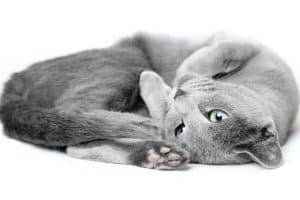
These Russian Blue cats were named after their unique coats. Their coats are lavender at the base, darkening along the shaft up to the tips of the fur that is sprinkled with shimmering silver. These cats are elegant, reserved but playful as they love to chase after toys and anything else that moves!
One of the more amusing features of the Russian Blues is their “smile” thanks to their slightly upturned mouth. Just as much as you would feel amused with these cats, the Russian Blue can also spend hours amusing itself and not mind being left home alone for the day. They'll still feel happy to see you once you arrive!
9. Bengal cat

Bengals have a short, fine, pelt-like coat that needs little grooming and tends to shed less than many breeds, which is why they often appear on hypoallergenic lists, although there's no good evidence that they make less Fel d 1. They are very active cats that need plenty of play. Bengal cats enjoy human company as often as they can and will cuddle up to their favorite humans. Meanwhile, Bengal cats are drawn to children and do favor their company because of their energetic nature.
10. Colorpoint Shorthair cat

The Colorpoint Shorthair is closely related to the Siamese. They are born an extrovert, making friends with people who are allergic to cats easier.
This cat busies itself showing love and affection to their owners. They are also remarkably sensitive to moods. So, if they sense their owners are close to tears, these cats will try to accompany them and bring comfort.
How To Live With A Cat When You Have Allergies
Choosing a lower-allergen cat is only half the job. These steps help cut the allergen load in your home, whatever breed you have:
- Meet the cat first. Spend a few hours with the individual cat, ideally on more than one visit, before you adopt.
- See an allergist. Testing confirms what you're allergic to, and treatments such as antihistamines, nasal sprays or allergy shots (immunotherapy) can help. If you have asthma, get advice before bringing a cat home.
- Keep the bedroom cat-free and run a HEPA air purifier there.
- Clean often: vacuum with a HEPA vacuum, wash bedding and throws weekly, and choose hard floors and washable covers where you can.
- Groom regularly, ideally done by a non-allergic family member, and wash your hands after handling your cat. Bathing lowers allergen levels only for a few days; see how to bathe a cat if you try it.
- Consider an allergen-reducing diet. Purina Pro Plan LiveClear contains an egg-based ingredient that binds Fel d 1 in the cat's saliva; Purina reports it reduces the allergens in hair and dander by an average of 47%, starting in the third week of daily feeding.
If your main concern is fur on your clothes and furniture rather than sneezing, see our guide to cats that don't shed.
Parting Words
While no cat breed is completely hypoallergenic, some breeds produce fewer allergens and may be better suited for allergy sufferers.
Our takeaway? Hypoallergenic cat breeds like the Siberian, Balinese, and Devon Rex offer a potential middle ground—letting cat lovers with mild sensitivities enjoy feline companionship with fewer sneezes. It's all about finding the right match and managing allergens with smart care and grooming routines.
Sources
- WebMD, “Do Hypoallergenic Cats Exist?“
- Purina, “A Major Breakthrough in Managing Cat Allergens“
- Wikipedia, “Fel d 1” (with links to the underlying studies)

